
Prime Minister Manmohan Singh in his Independence Day address in 2007 had announced setting up of 6,000 new high quality schools, one in every block of the country. The education sector as a whole received Rs 41,978.21 crore as against Rs 37,366.57 crore (Rs 373.66 billion) in the revised estimate of 2008-09 budget, showing a jump of Rs 4,611.64 crore (Rs 46.11 billion).
Following are the highlights of the Railway Budget 2006-07 presented by Union Railway Minister Lalu Prasad Yadav

'Like every Budget, this time, too, there is chatter around tinkering with the long-term capital gains tax.' 'Investors may not want to jump into the markets until there is clarity on this front.'

India's industrial production growth accelerated to 16-month high of 11.7 per cent in October, mainly due to double-digit growth in manufacturing, power and mining sectors' output, according to the official data released on Tuesday. The factory output growth measured in terms of the Index of Industrial Production (IIP) had contracted by 4.1 per cent in October 2022. The previous high of IIP growth was recorded at 12.6 per cent in June 2022.

The income tax department estimates total collection to be between Rs 10.5 trillion and Rs 10.7 trillion against the revised target of Rs 11.7 trillion.
The Railway Budget for 2003-04 has been fixed at Rs.10,607 crore (Rs 106.07 billion), Rs 603 crore (RS 6.03 billion) higher than the revised estimates of the current year.

A strong performance in the July-September quarter of 2023-24 (Q2FY24), an upward revision in the margin guidance and sustained momentum in US sales has helped the stock of pharmaceutical major Cipla gain about 2 per cent over the last two trading sessions. The brokerages have upgraded the earnings estimates for this financial year (FY24) by 6-9 per cent to factor in the improved margin guidance and sales in the US market. Led by the US market, which rose by 31 per cent, the company posted a 16 per cent growth in revenues.
Officials in North Block are wondering if a new tax will be mooted again and whether that will pertain to foreign investments.

The government's food subsidy in the ongoing fiscal year is expected to be a little less than Rs 4 trillion.

After underperforming its peers in the consumer space in 2022-23, and experiencing a mixed bag in the 2023-24 (FY24) April-June quarter (first quarter, or Q1), brokerages are positive about the medium-term outlook for liquor stocks. Higher raw material costs, concerns regarding increased duties, regulatory changes, and competitive pressures weighed on performance returns in the past quarters. Analysts believe that the sector could experience a reversal of fortunes due to better demand and margin improvements.

In the last budget, then finance minister Arun Jaitley had allocated Rs 85,010 crore for the education sector which was later revised to Rs 83,625.86 crore.

Sitharaman said the government will bring in a new national education policy to transform India's higher education system into one of the best in the world.

SBI Cards & Payment Services reported mixed results for the January-March quarter (Q4) of FY24. While it managed to deliver strong earnings growth, it saw a perceptible decline in net interest margin (NIM) and suffered deteriorating asset quality. Taken together, the market was disappointed with the share dropping 3.5 per cent.

The stock of consumer goods major Emami has corrected nearly 3.5 per cent since its 52-week high of Rs 546.25. On August 29, the stock closed at Rs 521.90 on the BSE. After underperforming the Nifty FMCG index for a long time, the stock is now doing a catch up and surged over 13 per cent in the past one month.

As many as 417 infrastructure projects, each entailing an investment of Rs 150 crore or more, have been hit by cost overruns of more than Rs 4.77 lakh crore in September this year, an official report said. According to the Ministry of Statistics and Programme Implementation, which monitors infrastructure projects worth Rs 150 crore and above, out of 1,763 projects, 417 reported cost overruns and as many as 842 projects were delayed. "Total original cost of implementation of the 1,763 projects was Rs 24,86,402.70 crore and their anticipated completion cost is likely to be Rs 29,64,345.13 crore, which reflects overall cost overruns of Rs 4,77,942.43 crore (19.22 per cent of original cost)," the ministry's latest report for September 2023 said.
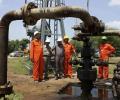
State-owned Oil and Natural Gas Corporation (ONGC) has cancelled the bids received for its Daman upside gas development project off the western coast due to high price quotes, sources said. The project is crucial to ONGC's strategy of ramping up gas production from its shallow-water fields off India's west coast. Once completed, the project would lead to nearly doubling of current gas production of 4-5 million standard cubic metres per day.
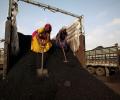
Conflicting views on Coal India (CIL) might leave investors confused. The bullish perspective that India has strong power demand (and also high steel production) means high demand for coal. As CIL is the monopoly producer of coal -- supplying over 80 per cent of the domestic requirement - the public sector undertaking should be a beneficiary of the rising power demand.

Investors shunned shares of Bajaj Finance on Friday, a day after the non-banking financial company (NBFC) reported a sharp contraction in its net interest margin (NIM) for the March quarter of the financial year 2023-24 (Q4FY24). The losses accounted for a fifth of the benchmark S&P BSE Sensex's 609-point loss. Most brokerages have tamed their earnings expectations for the next couple of quarters, after the management said it expected the pressure on NIMs to continue in the near term.

As per practice a vote-on-account or approval for essential government spending for a limited period is taken in the election year and a full-fledged budget presented by the new government.
With 11th Five Year plan giving special focus on education, government on Friday earmarked a whopping over Rs 38,702 crore (Rs 387.02 billion) to the sector in the Union Budget 2008-09, showing a massive increase of over Rs 9,000 crore (Rs 90 billion) .

India appears poised to sustain its growth in a more durable way than before with the economy carrying the momentum from FY23 into the current fiscal year, the Annual Economic Review for 2022-23 released by the finance ministry on Thursday said. However, the report cautioned that escalation of geopolitical stress, enhanced volatility in global financial systems, sharp price correction in global stock markets, a high magnitude of El-Nino impact, and modest trade activity and FDI inflows, are factors that could constrain the pace of growth. "Should these developments deepen and dampen growth in the subsequent quarters, the external sector may challenge India's growth outlook for FY24," the finance ministry said.
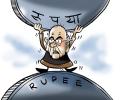
While the finance minister had a great opportunity to come out with flying colours while presenting this last Budget of his government, he didn't, says Omkar Goswami.

The 2.1 percentage point reduction mainly reflects the impact of recent fluctuations in US dollar exchange rates.

The government wants new domestic companies to set up their manufacturing units fast and hence the concessional tax rate of 15 per cent has been extended by a year till March 2024, revenue secretary Tarun Bajaj said on Friday. Stating that direct and indirect tax collections are going up and have good buoyancy, Bajaj said it means that the corporate sector is also doing well, and India's tax to GDP ratio could be "highest ever" in the current year. The Budget 2022-23 presented on February 1 has proposed that the concessional 15 per cent corporate tax rate would be available for one more year till March 2024 for newly incorporated manufacturing units.
Expressing determination to eliminate "all delays" in modernisation of the armed forces, the government on Thursday hiked the defence budget by a whopping 23 per cent to Rs 77,000 crore as against the revised estimates of Rs 63,000 crore.

Most of the scanty 6.35% rise in the defence budget is accounted for by manpower and running expenses.

RE of GDP for 2015-16 show that the economy grew 7.9% in 2015-16, rather than the earlier estimate of 7.6 per cent.

The government has limited room to reduce expenditure without further weakening growth, it noted.

Extreme poverty in India declined by 38 million in 2021 to 167.49 million after a surge in the two preceding years, but remained above the 2018 level, the latest World Bank data shows. While for most countries poverty rose in 2020, when the Covid-19 pandemic hit the global economy, the data shows poverty shot up in India a year earlier in 2019 to 176.09 million from 151.79 million in 2018, the lowest pre-pandemic count. India's poverty rate at 11.9 per cent in 2021 also remained higher than the 2018 level of 11.09 per cent, though easing from 14.72 per cent in 2020.
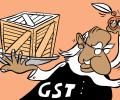
If other states follow suit, it is going to become difficult for the GST Council to decide on the next stage of reforms.

For the current fiscal which ends on March 31, it put the real GDP estimate at 5 per cent. It estimated a 7 per cent growth in 2022-23 and 2023-24 fiscal years. The inflation rate was seen moderating to 4.4 per cent in the next fiscal from 4.7 per cent in the current.

Various indicators make it amply clear that there are grave challenges facing the new government of Chief Minister Nitish Kumar, reports Indivjal Dhasmana.

An in-line ICICI Bank result for the quarter ended March 31, 2024, has led to analysts raising target price and earnings per share (EPS) forecast on the stock. ICICI Bank, they said, appeared least vulnerable to regulatory action on its digital offerings or for risk monitoring lapses.

Starting early will help departments to get funds faster.

India's economy grew by 1.6 per cent in the fourth quarter of 2020-21, restricting the full-year contraction to 7.3 per cent, official data showed on Monday. The fourth quarter growth was better than the 0.5 per cent expansion in the previous October-December quarter of 2020-21. The gross domestic product (GDP) had expanded by 3 per cent in the corresponding January-March period of 2019-20, according to data released by the National Statistical Office (NSO).

The U.S. economy grew faster than initially thought in the second quarter.
